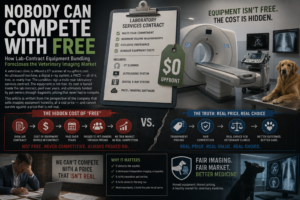
Veterinary Equipment Bundling: Nobody Can Compete With Free
“A veterinary clinic is offered a CT scanner at no upfront cost. An ultrasound machine, a digital x-ray system, a PACS — all of it, free, or nearly free. The condition: sign a multi-year laboratory-services contract. The equipment is not free. Its cost is buried inside the lab contract, paid over years, and ultimately funded by pet owners through diagnostic pricing that never had to compete. This article is written from the perspective of the company that sells imaging equipment honestly, at a real price — and cannot survive against a price that is not real.”
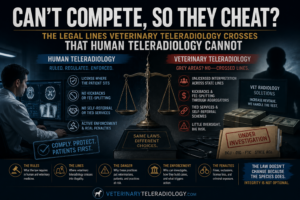
Can’t Compete, So The Cheat?
“Human teleradiology operates inside a dense, actively enforced legal structure: the interpreting radiologist must hold a license where the patient sits, and federal and state law forbid fee-splitting, kickbacks, self-referral, and the tying of diagnostic services to other purchases. Veterinary teleradiology is governed by the same underlying legal principles — and a corporate aggregator model that routinely crosses them. This article documents the rules, the lines, the danger, the enforcement pathways, and the penalties. You decide what to call it.”
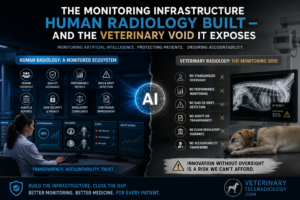
The Monitoring Infrastructure Human Radiology Built
“In May 2026, the American College of Radiology launched Assess-AI, which it describes as the world’s first AI quality registry for medical imaging, alongside a formal ACR-SIIM Practice Parameter for Imaging AI. The registry monitors the real-world performance of clinical imaging AI after deployment — detecting the performance drift and divergence-from-marketing that the human-side profession has formally acknowledged is routine. The United Kingdom’s Royal College of Radiologists has built parallel monitoring infrastructure. The human-medicine professional bodies recognized the problem and built the cure. The veterinary profession’s own specialty bodies issued a near-identical diagnosis in their 2025 position statement on veterinary AI — and built nothing.”
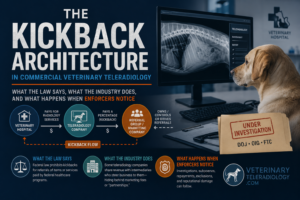
Veterinary Teleradiology Kickbacks: The Law & The Industry
“The federal Anti-Kickback Statute does not reach the veterinary side, but Nevada NRS 638.1404 prohibits referral compensation arrangements not disclosed to the client, Texas categorically prohibits them regardless of disclosure, and the AVMA Principles of Veterinary Medical Ethics state that “a veterinarian should not offer or receive any financial incentive solely for the referral of a patient.” Despite this legal architecture, the operational forms the prohibited conduct takes — published loyalty programs like IDEXX Points where points scale with referral volume, private per-study referral compensation characterized as marketing fees, equipment-placement deals tied to referral commitments, and corporate-consolidation revenue capture under vertically integrated structures like Mars Petcare’s Antech-AIS-VCA-Banfield architecture — remain a routine feature of the commercial market. This article documents the legal framework, the operational forms the prohibited conduct takes, the harm to patient care and client trust, and what happens when state attorneys general, state veterinary boards, or federal enforcers begin to take notice.”
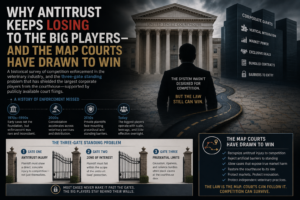
Why Veterinary Antitrust Cases Keep Failing on Standing
“A historical survey of competition enforcement in the veterinary industry, and the three-gate standing problem that has shielded the largest corporate players from the courthouse — supported by publicly available court filings.”
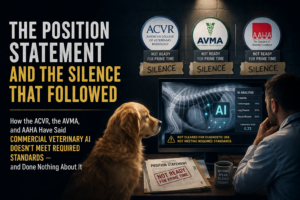
Vet AI Position Statement: 18 Months of Institutional Silence
“In March 2025, the American College of Veterinary Radiology and the European College of Veterinary Diagnostic Imaging published a joint position statement in JAVMA establishing that commercial veterinary AI radiology products do not currently meet the standards required for safe deployment in clinical practice. The position statement was the formal, peer-reviewed expression of the field’s specialty college finding that an entire commercial product category fails the threshold for clinical use. In the eighteen months since, the institutions positioned to act on the position statement’s findings have not done so. The ACVR has continued to host the same AI vendors as official conference partners. The AVMA has issued no policy resolution and modified no corporate-relationship framework. AAHA, the only voluntary accrediting body for companion-animal veterinary hospitals in the United States and Canada, has completed the first comprehensive Standards of Accreditation refresh in its 90-year history without adding any standard that would constrain commercial AI radiology products. The institutional inaction is consistent across all three institutions, occurring in the same eighteen-month window, with the same documented professional notice, and with the same documented corporate sponsorship architecture connecting each institution to the corporate parents of the AI vendors at issue. This article documents what was said, what was not done, and why the structural pattern of inaction is explicable by examining how veterinary professional self-regulation is funded and organized.”